Parigi, 3 ottobre 2026 – Mediante i loro distinti linguaggi artistici questi artisti condividono una comune attenzione al movimento, alla trasformazione e al mondo vivente: il fiore che sboccia, la foglia, la goccia di rugiada, la curva di un corpo o di una linea; così come il volto, l’occhio e la mano; tutto diviene un punto di partenza per la creazione di gioielli che trascendono la loro funzione ornamentale per assurgere a vere e proprie sculture da indossare.

SCULTURE DA INDOSSARE
Ad aprire il percorso espositivo è il frutto della collaborazione tra Éric de Dormael e Agnès Baillon, immersi in una dimensione onirica, laddove strutture metalliche avvolgono ed estendono figure modellate e volti, occhi e mani si dispiegano tra cornici geometriche, curve, volute e ramificazioni. Nelle forme più organiche, attraverso la femminilità emergono riferimenti all’Art Nouveau, gli arabeschi e la preziosità della foglia d’oro. I ritratti in miniatura assumono così la forma di cammei contemporanei, reinterpretati all’interno di composizioni libere e decisamente attuali. Questo mondo immaginario dialoga anche con il Rinascimento. Il Collier cheveux dorés, composto da tre volti, evoca infatti le “Tre Grazie” e in generale il mondo del Botticelli, attraverso la delicatezza dei tratti, i capelli dorati e l’equilibrio della composizione. A questa tradizione classica si contrappone una vena più surrealista, nella quale l’occhio diventa spilla o pendente in un gioco di metamorfosi che richiama Dalí o Magritte.
PARCOURS BIJOUX 2026
On the occasion of Parcours Bijoux 2026, Galerie Negropontes presents a selection of works by creators Éric de Dormael, Agnès Baillon, Walid Akkad, Jean-Christophe Malaval, and Elena Syraka. Through their own distinct artistic languages, these artists share a common attentiveness to movement, transformation, and the living world. The blossoming flower, the leaf, the dewdrop, the curve of a body or a line, as well as the face, the eye, and the hand, become the starting points for jewellery that transcends its ornamental function to assert itself as true wearable sculpture.
Agnès Baillon & Éric de Dormael, Collier cheveux dorés
The collaborative work of Éric de Dormael and Agnès Baillon opens the exhibition into an oneiric realm, where metal structures surround and extend modelled figures: faces, eyes and hands unfold among geometric frames, curves, volutes and branches. In the more organic forms, references to Art Nouveau emerge through femininity, arabesques and the preciousness of gold leaf. The miniature portraits thus become contemporary cameos, reinterpreted within compositions that are free and resolutely contemporary. This imaginary world also enters into dialogue with the Renaissance. The Collier cheveux dorés, composed of three faces, evokes the Three Graces and, more broadly, the world of Botticelli, through the delicacy of the features, the golden hair and the balance of the composition.
CLASSIC AND SURREALISTIC
This classical lineage is counterbalanced by a more Surrealist vein: the eye becomes a brooch or pendant, in a play of metamorphoses that may recall Dalí or Magritte. In Walid Akkad’s work, nature is less represented than it is embedded within the very construction of the jewellery. Born from drawing, each volume captures a movement and unfolds like an architecture that is both light and powerful. Some pieces seem to catch a flower at the precise moment of its opening: gold bends, curls and unfurls like petals in the making. This relationship with the vegetal world runs throughout his visual vocabulary, conceived as a garden in which lines, volumes, colours, metal and stones all partake in the same impulse. His mastery of sculpture, polishing and the different nuances of gold gives the dense material an almost living suppleness.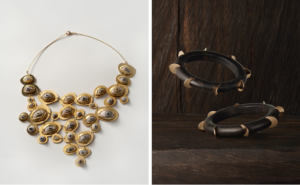
Agnès Baillon et Éric de Dormael, Collier golden eyes / Walid Akkad, Bracelets Noria, Or rouge et ébène du Gabon
This idea of growth and transformation finds an echo in the work of Jean-Christophe Malaval. With Tummelisa, a sculpted silver and gold ring, a unique piece created in 2025, the form is structured around a vegetal vocabulary evoking a flower laden with dew. The convex surfaces, recesses and flashes of metal create the impression of a material in the process of taking shape, somewhere between petal and drop of water. This reflection takes on another dimension with Infini. Its form turns back upon itself, blurring any perception of a beginning or an end. Here, infinity is not a symbol added to the jewellery: it emerges directly from its construction. The line continues, reverses itself, and returns towards itself. The gesture thus connects with one of nature’s fundamental rhythms: that of cycles, renewal and metamorphosis.
Walid Akkad, Bague double Trois gouttes, Or rouge
In Elena Syraka’s work too, references to the vegetal world notably emerge through the leaf. One ring takes up this form with an economy of means reminiscent of Matisse’s cut-out vocabulary: nature is less represented, reduced to an essential silhouette, rhythm and line. At once immediately recognisable and almost abstract, the leaf becomes a sign. From one artist to another, the vegetal world is therefore not simply a decorative repertoire. It becomes a way of thinking about form: something that grows, opens, unfolds and transforms. Through their creations, jewellery becomes, in turn, an organism, a talisman, a portrait or a fragment of a dream. It is worn, but also contemplated as an autonomous work of art, capable of transforming our perception of the body as much as that of the object.

Elena Syraka, MATISSE , GEA016A, Leaf Ruby & tourmaline / Elena Syraka, MATISSE, GR024A Leaf tourmaline
INFO
Galerie Negropontes participates in Parcours Bijoux, dedicated to contemporary jewellery; Galerie Negropontes, Paris: October 1 – 31, 2026;
Galerie Negropontes Paris: 14-16 rue Jean-Jacques Rousseau, 75001 Paris – France;
Sestiere Dorsodouro, 3900, Venezia (30123) – Italia;